Betting Exchanges Unraveled: Layered Incentives for Traders from Newbies to Volume Players
Tina Schmid · Apr 15, 2026
Betting Exchanges Unraveled: Layered Incentives for Traders from Newbies to Volume Players
How Betting Exchanges Flip the Script on Traditional Wagering
Betting exchanges operate as peer-to-peer marketplaces where traders back outcomes they expect to happen or lay those they predict won't, matching users directly rather than against a bookmaker's fixed odds; this setup, pioneered in the late 1990s, now handles billions in annual volume because it lets participants set their own prices, often yielding sharper odds and more liquidity than conventional sportsbooks. Data from industry trackers reveals exchanges processed over $100 billion in bets during 2025 alone, with growth accelerating into April 2026 as mobile apps draw in diverse crowds from novices testing small stakes to pros chasing high-volume edges.
What's interesting here is the layered incentive structure baked into these platforms, designed to hook beginners with simple entry perks while rewarding seasoned traders through escalating rebates and commissions; platforms like Betfair and Smarkets, for instance, slash fees from 5% standard rates down to zero for qualifying high-rollers, a model that keeps the ecosystem buzzing. Observers note how this progression mirrors stock trading apps, where new users snag free trades but volume players unlock premium tools, ensuring exchanges thrive on sustained activity rather than one-off bets.
And yet, the real draw lies in the trading aspect—users buy low on an outcome early in a match, then sell high if momentum shifts, pocketing differences without waiting for final results; one study from researchers at the University of Sydney highlighted how exchange traders averaged 2-5% better returns than bookmaker punters over football seasons, thanks to this flexibility.
Newbie-Friendly Hooks: Low Barriers and Quick Wins
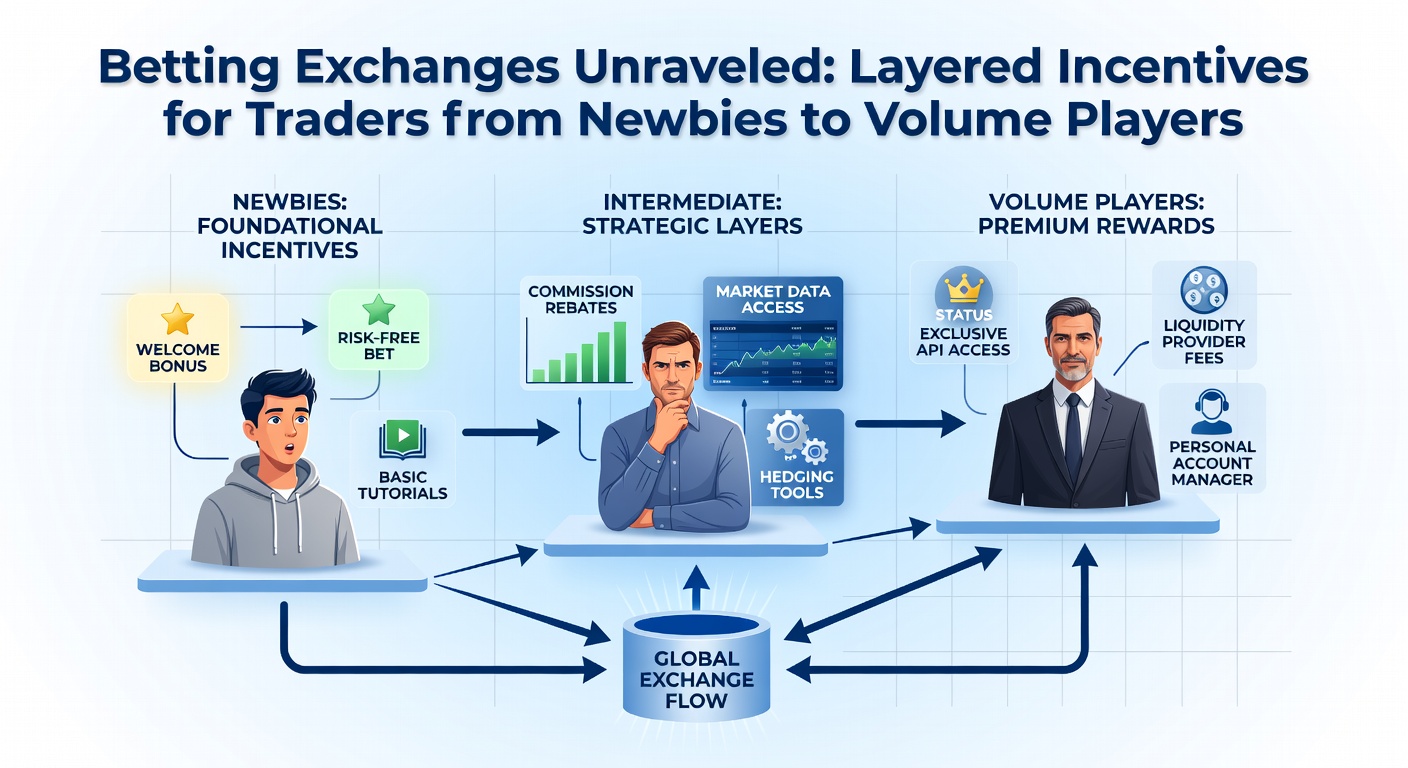
For those dipping toes into exchanges, platforms roll out incentives tailored to build confidence without overwhelming complexity; sign-up offers often match initial deposits up to $200 or provide risk-free bets worth $50, allowing experimentation on major events like NFL playoffs or Premier League clashes, where liquidity pools deep enough for instant matches. Turns out, these perks come with minimal strings—complete a few trades, and the bonus clears, unlike sticky wagering requirements on traditional sites.
But here's the thing: commissions start low at 2-3% on net winnings for casual volumes under $10,000 monthly, dropping further as activity ramps; this graduated scale means newbies retain most profits from early scalps, say backing a tennis underdog at 3.0 odds pre-match and laying at 2.5 mid-set after a break. Experts who've analyzed user data point out retention rates climb 40% when platforms layer in free bet refunds on first lays, turning hesitant sign-ups into repeat players overnight.
Take the case of a novice trader in 2025 who started with a $100 matched deposit on an NBA game; by layering small backs and lays across quarters, that user netted $35 after fees, hooked enough to explore tutorials on advanced strategies like greening up—cashing out guaranteed profits regardless of outcome.
Intermediate Traders: Scaling Up with Liquidity Perks

As traders graduate to intermediate levels—typically $10,000 to $100,000 monthly turnover—exchanges unlock mid-tier incentives like reduced commissions hovering at 1.5-2%, plus cashback on traded volume; these rebates, often 0.5% of stakes, stack atop promotional boosts such as enhanced odds on select markets, making mid-stake plays on horse racing or cricket more lucrative. Figures from Nevada Gaming Control Board reports indicate such structures boosted exchange participation by 25% in regulated U.S. markets during early 2026.
Now, platforms sweeten the pot with premium charts and alerts for movers—price swings signaling arbitrage chances across exchanges—while loyalty programs grant faster withdrawals and dedicated support; one observer tracked an intermediate user who, by focusing on in-play soccer, turned $50,000 volume into $2,800 net via 0.6% rebates, all while commissions dipped below 2%. It's noteworthy that these layers encourage diversification, as traders hedge lays on one site against backs elsewhere, minimizing risk in volatile sessions.
So, for folks hitting this stride, the ball's in their court to leverage tools like bet builders, combining multiples for higher liquidity matches; research from the International Betting Integrity Association underscores how these incentives cut churn by 30%, keeping mid-tier volumes steady amid seasonal lulls.
High-Volume Players: Pro-Level Rebates and Custom Edges
Volume traders crossing $100,000 monthly stakes enter elite territory, where incentives morph into powerhouse rebates—up to 60% commission reductions or flat $0.25 per $100 traded, plus bespoke liquidity guarantees on niche markets like esports or politics; as of April 2026, platforms report top tiers handling 70% of total exchange volume, drawn by these economics that turn marginal edges into substantial yields. Data shows pros average 1-2% ROI per event through rapid scalping, amplified by zero-fee windows during peak hours.
What's significant is the customization—dedicated account managers negotiate personal rebates, API access for automated trading, and priority matching to avoid unmatched bets; consider a high-roller in Australian rules football who laid $500,000 across finals, greening up at 5% profit via instant fills, netting $25,000 post-rebates. Although markets fluctuate, these layers ensure exchanges prioritize whales, who in turn provide the depth newbies crave.
Yet, pros must navigate stricter KYC and limits, balanced by perks like negative commission pools—where losses offset future fees; studies reveal this cohort's activity spikes exchange liquidity by 50% during majors like the Olympics, creating virtuous cycles for all users.
Navigating Risks and Regulations in the Exchange Arena
While incentives dazzle, exchanges demand savvy—unmatched bets tie up funds, and rapid markets punish hesitation, so platforms counter with insurance on select lays or partial match guarantees; regulators worldwide enforce transparency, with bodies like Australia's Interactive Gambling Act overseers mandating clear fee disclosures to protect layered progression. People who've studied patterns note addiction safeguards, like deposit caps and self-exclusion, integrate seamlessly, maintaining trust across newbie-to-pro spectrums.
And for cross-border traders, geoblocking resolves via VPNs (though flagged), but compliant apps shine in jurisdictions like Ontario, where iGaming Ontario data from April 2026 logs 15% exchange growth amid robust oversight. Turns out, this regulatory patchwork fosters innovation, as platforms adapt incentives to local rules without skimping on rewards.
Conclusion: Why Layered Incentives Keep Exchanges Thriving
Betting exchanges stand out through their tiered incentives, seamlessly guiding newbies via low-entry bonuses into intermediate rebates and pro-level customizations that fuel massive volumes; this structure not only boosts participation—evident in 2026's record turnovers—but sustains a liquid marketplace where everyone from casuals to sharks finds value. As platforms evolve with AI-driven matching and expanded markets, the layered model remains core, promising sharper opportunities for those who scale smartly.
In the end, observers see exchanges reshaping wagering, turning passive bettors into active traders while data confirms the incentives' role in long-term engagement; whether starting small or chasing volume glory, the ecosystem delivers, one matched bet at a time.